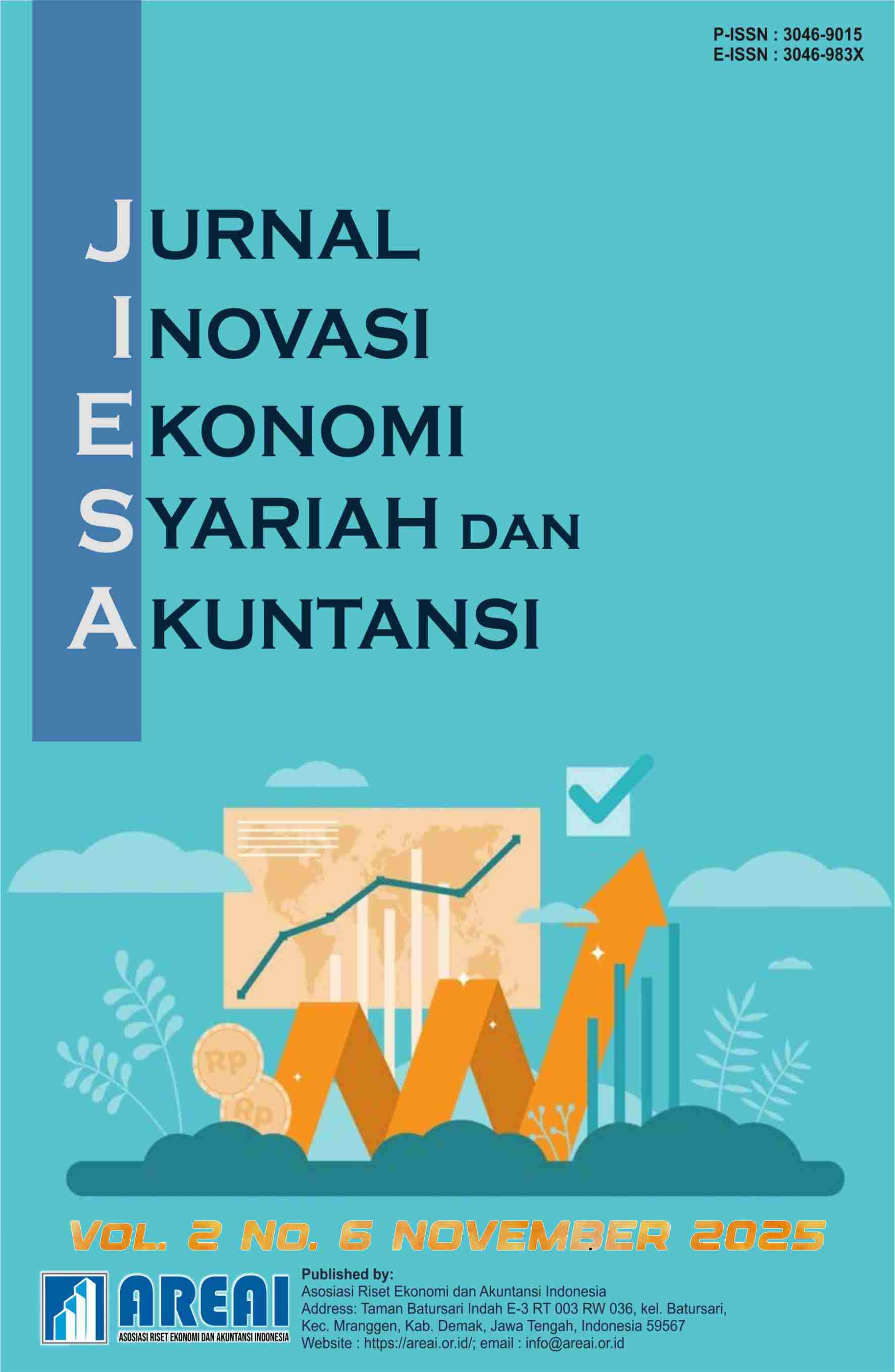
Pengaruh Finansial Technology Literasi Keuangan terhadap Kinerja UMKM dengan Inklusi Keuangan sebagai Variabel Moderasi
Studi Kasus Usaha Mikro di Kota Bandar Lampung
DOI:
https://doi.org/10.61132/jiesa.v3i1.2036Keywords:
Financial Inclusion, Financial Literacy, Financial Technology, MSME Performance, MSMEsAbstract
With financial inclusion acting as a moderator, the goal of this study is to examine how financial technology use and financial literacy impact microbusiness performance. Microbusinesses in Bandar Lampung City's food and beverage industry serve as the research subjects. This study employs a quantitative approach, using questionnaires to collect primary data from microenterprises. Purposeful sampling was used to choose 203 microbusinesses that met the research criteria. SPSS was utilized to analyze the data using multiple linear regression and Moderated Regression Analysis (MRA). The study's conclusions imply that the use of financial technology has an effect on microenterprises' performance. Additionally, it has been shown that financial literacy affects microenterprise performance. The findings show that key components in increasing microbusiness performance are the use of financial technology and the entrepreneur's capacity to supervise and make financial decisions. However, the test results indicate that financial inclusion cannot boost the impact of financial technology and financial expertise on microbusiness performance. This implies that the influence of financial technology and financial knowledge on business success is not necessarily enhanced by having access to financial services. It also shows that a key factor in increasing the success of microbusinesses is the characteristics of the entrepreneur. The research's objectives are to assist important stakeholders in creating plans for microenterprise growth, as well as to assist microenterprise actors in improving their financial literacy and utilizing financial technology to its fullest.
Downloads
References
Adha, N., Mustari, Ampa, A. T., Dinar, M., & Rahmatullah. (2024). Pengaruh kinerja usaha kuliner dengan inklusi keuangan sebagai variabel moderasi. Humano, 15(1), 381–393. https://doi.org/http://ejournal.unkhair.ac.id/index.php/humano
Anggriani, I., Armiani, & Wahyullah, M. (2023). Pengaruh inklusi keuangan, literasi keuangan, dan pengelolaan keuangan terhadap kinerja UMKM di Kabupaten Dompu. Jurnal Ilmiah Ekonomi dan Bisnis, 2(3), 598–609. https://doi.org/10.48175/ijarsct-13062
Ayem, S., & Afrianingrum, R. W. (2025). Financial inclusion moderates the determinants of SME’s financial performance. Jurnal Akademi Akuntansi, 8(3), 415–433. https://ejournal.umm.ac.id/index.php/jaa/article/view/39621
Badan Pusat Statistik Provinsi Lampung. (2025). Provinsi Lampung dalam angka 2025 (Vol. 56). BPS Provinsi Lampung.
Chenhall, R. H. (2003). Management control systems design within its organizational context: Findings from contingency‐based research and directions for the future. Accounting, Organizations and Society, 28(2–3), 127–168. https://doi.org/10.1016/S0361-3682(01)00027-7
Ghozali, I. (2021). Aplikasi analisis multivariate dengan program SPSS 26. Badan Penerbit Universitas Diponegoro.
Gujarati, D. N. (2003). Basic econometrics (4th ed.). McGraw-Hill. http://zalamsyah.staff.unja.ac.id/wp-content/uploads/sites/286/2019/11/7-Basic-Econometrics-4th-Ed.-Gujarati.pdf
Hapsari, A. (2023). Pengaruh financial literacy, financial technology, dan financial inclusion terhadap kinerja UMKM di Semarang (Skripsi, Universitas Islam Sultan Agung). Repositori Universitas Islam Sultan Agung. https://repository.unissula.ac.id
Herdinata, C., & Pranatasari, F. D. (2020). Literasi keuangan berbasis financial technology bagi usaha mikro, kecil, dan menengah. Deepublish.
Kadin Indonesia. (2024). UMKM Indonesia. https://kadin.id/data-dan-statistik/umkm-indonesia/
Kasmir. (2021). Analisis laporan keuangan. PT RajaGrafindo Persada.
Kementerian Sekretariat Negara Republik Indonesia. (2020). Peraturan Presiden Republik Indonesia Nomor 114 Tahun 2020 tentang Strategi Nasional Keuangan Inklusif.
Lembaga Penjamin Simpanan. (2024). Laporan kelembagaan LPS triwulan III 2024 (pp. 1–23). https://lps.go.id/laporan-kelembagaan-lps-triwulan-iii-2024/
Mirdiyantika, A., Indriasari, I., & Meiriyanti, R. (2023). Pengaruh literasi keuangan, inklusi keuangan, dan financial technology terhadap peningkatan kinerja UMKM di Kecamatan Bulakamba. Jurnal Riset Manajemen dan Ekonomi (JRIME), 1(2), 30–47. https://doi.org/10.54066/jrime-itb.v1i2.139
Otoritas Jasa Keuangan. (2016). Peraturan Otoritas Jasa Keuangan Nomor 76/POJK.07/2016 tentang peningkatan literasi dan inklusi keuangan di sektor jasa keuangan bagi konsumen dan/atau masyarakat. https://ojk.go.id
Otoritas Jasa Keuangan. (2024a). Edukasi keuangan. https://ojk.go.id/id/kanal/edukasi-dan-perlindungan-konsumen/Pages/literasi-keuangan.aspx
Otoritas Jasa Keuangan. (2024b). Statistik perbankan Indonesia. Departemen Pengelolaan Data dan Statistik Otoritas Jasa Keuangan.
Otoritas Jasa Keuangan. (2024c). Survei nasional literasi dan inklusi keuangan (SNLIK) 2024. https://ojk.go.id
Pandak, A., & Nugroho, D. S. (2023). Pengaruh financial technology dan kemampuan manajerial terhadap kinerja keuangan UMKM. Indonesian Journal of Multidisciplinary on Social and Technology, 1(3), 311–320. https://doi.org/10.31004/ijmst.v1i3.216
Pemerintah Indonesia. (2021). Peraturan Pemerintah Republik Indonesia Nomor 7 Tahun 2021 tentang kemudahan, pelindungan, dan pemberdayaan koperasi dan usaha mikro, kecil, dan menengah.
Pranisya, R., Sari, P. P., & Maulida, A. (2024). The effect of financial literacy, technology financial literacy, and financial inclusion on MSME performance. Jurnal Ekonomi dan Bisnis, 25(2), 244–255. https://doi.org/10.30659/ekobis.25.2.244-255
Putri, D. A. P. Y., Armiani, A., & Setiawati, E. (2024). Pengaruh literasi keuangan, payment gateway, peer-to-peer lending, dan inklusi keuangan terhadap kinerja keuangan. Kompeten: Jurnal Ilmiah Ekonomi dan Bisnis, 3(3), 972–985. https://doi.org/10.57141/kompeten.v3i3.15
Rahadjeng, E. R., Pratikto, H., Mukhlis, I., Restuningdiah, N., & Mala, I. K. (2023). The impact of financial literacy, financial technology, and financial inclusion on SME business performance in Malang Raya, Indonesia. Journal of Social Economics Research, 10(4), 146–160. https://doi.org/10.18488/35.v10i4.3509
Rahmawati, A., Wicaksono, A., Fahriani, D., Anwar, C., & Keuangan, L. (2025). Pengaruh literasi keuangan dan financial technology terhadap kinerja keuangan UMKM di wilayah Kahuripan. JIIP (Jurnal Ilmiah Ilmu Pendidikan), 8(5), 5261–5269. http://jiip.stkipyapisdompu.ac.id
Rani, G. M., & Desiyanti, R. (2024). Pengaruh literasi keuangan, inklusi keuangan, dan digital payment terhadap kinerja UMKM makanan dan minuman di Kota Padang. EKOMABIS: Jurnal Ekonomi Manajemen Bisnis, 5(2), 161–174. https://doi.org/10.37366/ekomabis.v5i02.1403
Setyawati, A. (2017). Keunggulan bersaing dan kinerja UMKM. Media Nusa Creative.
Siyami, N., & Rusmiyatun. (2023). The effect of technology literacy, financial literacy, and financial technology on the financial performance of MSMEs in Purworejo Regency moderated by financial inclusion. In Proceedings of the International Conference (pp. 942–947). https://doi.org/10.2991/978-2-494069-49-7_159
Strategi Nasional Keuangan Inklusif. (2017). Keuangan inklusif. https://snki.go.id/keuangan-inklusif/
Sugiyono. (2023). Metode penelitian kualitatif dan R&D. Alfabeta.
Undang-Undang Republik Indonesia Nomor 20 Tahun 2008 tentang usaha mikro, kecil, dan menengah. (2008).
Downloads
Published
How to Cite
Issue
Section
License
Copyright (c) 2026 Jurnal Inovasi Ekonomi Syariah dan Akuntansi

This work is licensed under a Creative Commons Attribution-ShareAlike 4.0 International License.