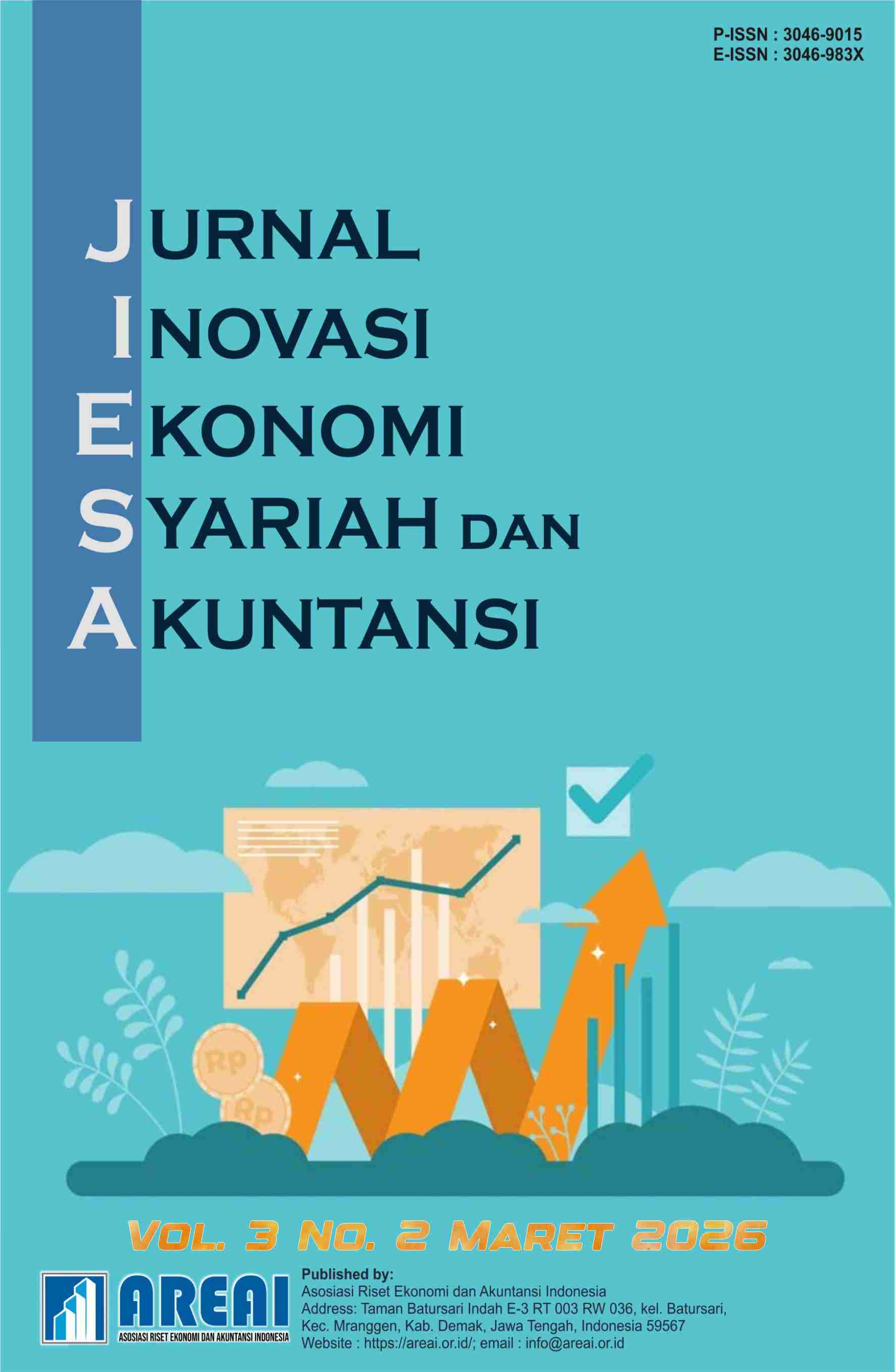
Analisis Maqashid Syariah dalam Praktik Halal Marketing : Tinjauan pada Pemasaran Digital, Layanan, dan Administrasi Usaha
DOI:
https://doi.org/10.61132/jiesa.v3i2.2148Keywords:
Business Administration, Customer Service, Digital Marketing, Halal Marketing, Maqashid SyariahAbstract
This study is developed as a conceptual paper that analyzes halal marketing practices through a maqashid shariah lens across three operational domains: digital marketing, customer service and business administration. The paper is motivated by recent developments in the global halal economy, the stronger linkage between halal assurance, governance quality and digital transparency, and Indonesia's policy acceleration toward mandatory halal implementation in October 2026. Methodologically, the study uses a structured literature review and conceptual synthesis of international reputable journals and relevant Indonesian journals, complemented by policy and industry reports. The analysis maps prior findings into maqashid dimensions (protection of religion, life, intellect, wealth and dignity) and translates them into practical indicators of honesty, transparency, fairness, consumer protection and procedural reliability. The paper argues that credible halal marketing depends not only on promotional messages but also on service conduct and disciplined administrative governance. It contributes a conceptual framework and practical propositions for evaluating halal marketing practices in MSMEs and service businesses.
Downloads
References
ANTARA. (2025). Indonesia retains third place on global Islamic economy index. 1–6.
Ashraf, M. A. (2019). Islamic marketing and consumer behavior toward halal food purchase in Bangladesh: An analysis using SEM. Journal of Islamic Marketing, 10(3), 893–910. https://doi.org/10.1108/JIMA-03-2018-0051
Badan Penyelenggara Jaminan Produk Halal (BPJPH). (2025). Pemerintah gratiskan 1,35 juta sertifikat halal bagi usaha mikro dan kecil di tahun 2026. 1–5.
Badan Penyelenggara Jaminan Produk Halal (BPJPH). (2026). BPJPH pastikan wajib halal Oktober 2026 tingkatkan kepercayaan konsumen dan daya saing produk nasional. 2–5.
DinarStandard. (2025). State of the Global Islamic Economy 2025 (SGIE 2024/2025 highlights).
Hoque, M. E., & Hashim, N. M. H. (2018). Conceptual framework: Moderating effects of marketing communication and financial consideration on customer attitude and intention to purchase Islamic banking products. https://doi.org/10.1108/JIMA-01-2017-0005
Iranmanesh, M., Senali, M. G., Ghobakhloo, M., Nikbin, D., & Abbasi, G. A. (2021). Customer behaviour towards halal food: A systematic review and agenda for future research. Journal of Islamic Marketing, 13(9), 1901–1917. https://doi.org/10.1108/JIMA-01-2021-0031
Sari, M., & Rahayu, S. S. (2024). Sentiment analysis on halal traceability: Dimensions based literature index. Halal Studies, 2(1), 1–27. https://doi.org/10.58968/hs.v2i1.496
Shah, S. A. A., Sukmana, R., Fianto, B. A., Ahmad, M. A., Usman, I. U., & Mallah, W. A. (2020). Effects of halal social media and customer engagement on brand satisfaction of Muslim customers: Exploring the moderation of religiosity. Journal of Islamic Marketing, 11(6), 1671–1689. https://doi.org/10.1108/JIMA-06-2019-0119
Shah, S. A., Bhutto, M. H., & Azhar, S. M. (2021). Integrative review of Islamic marketing. Journal of Islamic Marketing, 13(6), 1264–1287. https://doi.org/10.1108/JIMA-07-2020-0216
Susanty, A. (2025). Consumer acceptance of halal food traceability systems. Journal of Food Systems and Marketing, 1–20.
Times of India. (2025). Saudi Halal Centre unveils new halal mark with ESG standards. 26–27.
Wibowo, D. E., Soeharto, A., & Begishev, I. (2024). Internationalization of halal product assurance standards in Indonesia in ensuring consumer rights: Implications and orientation. Jurnal Suara Hukum, 1–30.
Yuliana, I., Wahyuni, N., & Sawitri, D. (2024). Strategi pengembangan industri halal di Indonesia berbasis maqashid syariah dan etika bisnis islami. 10(03), 3075–3086.
Yuningsih, A. A. M., Putri, R. E., & Jubba, H. (2023). Implikasi sertifikasi halal terhadap perkembangan industri halal di Indonesia. 8(2), 159–175. https://doi.org/10.21093/at.v8i2.7652
Downloads
Published
How to Cite
Issue
Section
License
Copyright (c) 2026 Jurnal Inovasi Ekonomi Syariah dan Akuntansi

This work is licensed under a Creative Commons Attribution-ShareAlike 4.0 International License.