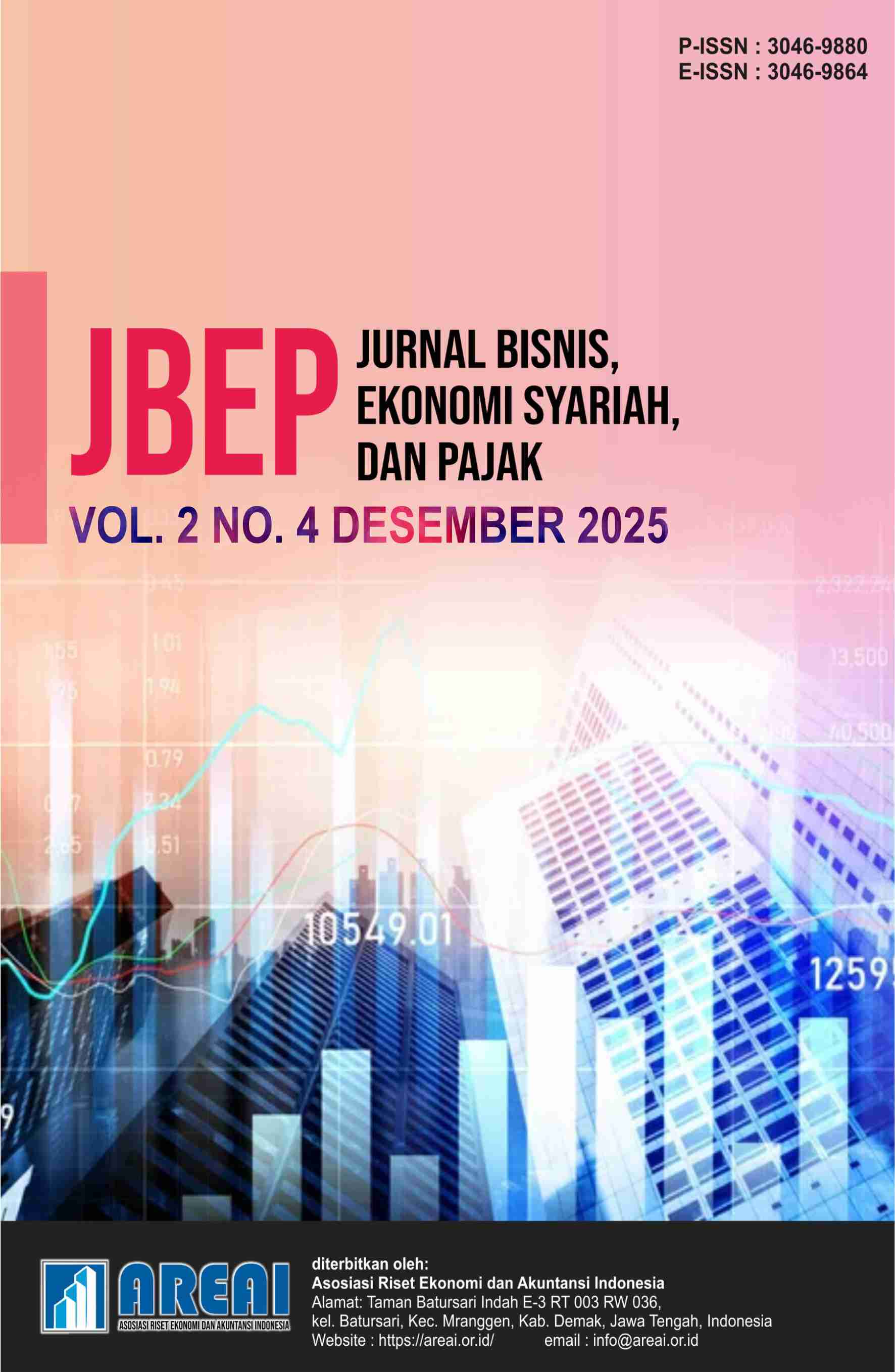
Pengaruh Upah Minimum terhadap Ketimpangan dan Kemiskinan di Pulau Jawa
DOI:
https://doi.org/10.61132/jbep.v2i4.1909Keywords:
Economic Growth, Income Inequality, Minimum Wage, Poverty, UnemploymentAbstract
Income inequality and poverty continue to be major challenges in Indonesia's industrial areas, especially in DKI Jakarta, West Java, and Banten, although minimum wage policies continue to be developed as a form of protection for low-income workers. These policies theoretically serve as an instrument for income redistribution and improvement of labor welfare, but their effectiveness in reducing inequality and reducing poverty rates is still questionable, especially in areas with highly industrialized economic structures. This study aims to analyze the influence of income inequality, poverty rate, economic growth, and unemployment rate on the dynamics of the provincial minimum wage in the 2016–2023 period. The study used secondary data obtained from the Central Statistics Agency and analyzed using panel data regression to obtain a comprehensive empirical picture of the factors determining the minimum wage. The test results show that the Fixed Effect Model is the most suitable model for capturing variations between provinces and between times. Key findings reveal that poverty levels and economic growth have a significant influence on changes in the minimum wage, while income inequality and unemployment rates have no significant influence. The conclusion of the study emphasizes that the minimum wage policy is not effective enough in reducing income inequality and reducing poverty without the expansion of the formal sector, improving the quality of the workforce, and distributing economic growth more evenly between industrial areas.
Downloads
References
Barro, R. J. (1999). Inequality and growth in a panel of countries. Harvard University.
Bernstein, J., Campolieti, M., Cardoso, A. R., Couch, K., Cunningham, W., Karageorgiou, L., Leigh, A., Maloney, W., Michl, T., Reich, M., Sabia, J., Schiller, B., Skedinger, P., Wessels, W., & Wise, D. (2006). Minimum wages and employment: A review of evidence from the new minimum wage research.
Cunningham, W. (n.d.). Minimum wages and social policy: Lessons from developing countries.
García-Gómez, C., Pérez, A., & Prieto-Alaiz, M. (2025). The risk of clustering of deprivations in Spain: A tale of two crises. Applied Economic Analysis, 33(97), 53–75. https://doi.org/10.1108/AEA-03-2024-0113
Gini, C. (1921). Measurement of inequality of incomes. The Economic Journal, 31(121), 124–126. https://doi.org/10.2307/2223319
Ilmiah, J. (2015). Analisis dampak kebijakan upah minimum.
International Labour Organization. (2009). 18th International Conference of Labour Statisticians: The concepts of employment and unemployment as set out by the 13th ICLS—Is there a need for revision?
Jimenez, E. (2015). Editor’s note. World Bank Research Observer, 1–2. https://doi.org/10.1093/wbro/lkv003
Lee, W., & Roemer, J. E. (2005). The rise and fall of unionised labour markets: A political economy approach. The Economic Journal, 115(500), 28–67. https://doi.org/10.1111/j.1468-0297.2004.00959.x
Lorenz, M. O. (1905). Methods of measuring the concentration of wealth. Publications of the American Statistical Association, 9(70), 209–219. https://doi.org/10.1080/15225437.1905.10503443
Muslim, M. R. (2014). Pengangguran terbuka dan determinannya. 15, 171–181.
Perwira, D., & Stokes, K. (2001). Wage and employment effects of minimum wage policy in the Indonesian urban labor market. SMERU Research Institute.
Plosser, C. I., & Schwert, G. W. (1979). Money, income, and sunspots: Measuring economic relationships. Journal of Monetary Economics, 15, 179. https://doi.org/10.1016/0167-2231(79)90009-5
Priseptian, L., & Primandhana, W. P. (2022). Analisis faktor-faktor yang mempengaruhi kemiskinan. Jurnal Forum Ekonomi, 24(1), 45–53. https://doi.org/10.30872/jfor.v24i1.10362
Rohmah, Z., & Sastiono, P. (2021). Pengaruh kebijakan peningkatan upah minimum terhadap ketimpangan upah (Studi kasus provinsi-provinsi di Jawa). Jurnal Ekonomi dan Pembangunan Indonesia, 21(2). https://doi.org/10.21002/jepi.2021.15
Solow, R. M. (1956). A contribution to the theory of economic growth. Quarterly Journal of Economics, 70(1), 65–94. https://doi.org/10.2307/1884513
Stone, R. (2019). Beyond GDP: Measuring what counts for economic and social performance. Journal of Social and Economic Performance, 12(5), 172–180. https://doi.org/10.24833/2071-8160-2019-5-68-172-180
Wihardja, M. M., & Cunningham, W. (2021). Pathways to middle-class jobs in Indonesia. World Bank. https://doi.org/10.1596/35848
Wulandari, N. (2017). Analisis faktor-faktor yang mempengaruhi inflasi pada kota metropolitan di Indonesia dengan menggunakan analisis data panel. 3(2), 34–42.
Downloads
Published
How to Cite
Issue
Section
License
Copyright (c) 2025 Jurnal Bisnis, Ekonomi Syariah, dan Pajak

This work is licensed under a Creative Commons Attribution-ShareAlike 4.0 International License.